A Founder’s Message: Why We Created FanCOMM2™ When Social Media Already Exists
Social media connects people. But who connects businesses to one another—and turns those connections into commerce?
Imagine a coworking campus with 2,000 businesses operating under one roof.
They share the same address, elevators, meeting rooms, coffee stations, and parking spaces. Yet many may not know what the businesses next door actually do.
One company needs payroll services. Another company in the same building provides payroll solutions.
One needs a website. Another develops websites.
One is planning a corporate event. Another provides event management, catering, photography, or entertainment.
The buyers and sellers are already in the same building. Yet they may be spending money advertising to strangers on social media while remaining invisible to one another.
This is one of the problems that inspired FanCOMM2™.
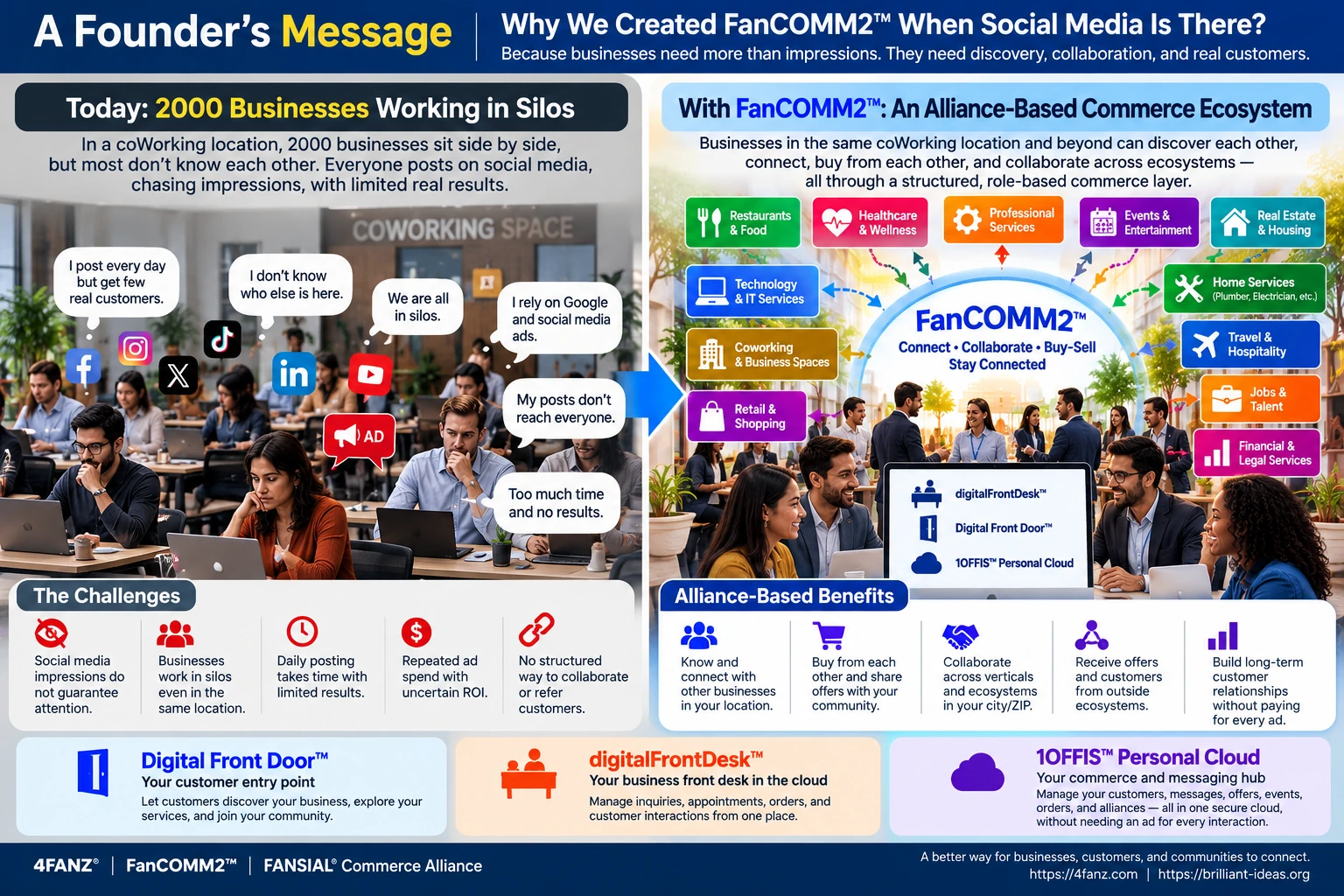
Concept illustration. The 2,000-business campus is an illustrative example, not a claim about current membership or measured results.
What Changes When Those 2,000 Businesses Become an Alliance?
Instead of operating as 2,000 isolated companies, imagine they become members of a shared commerce community.
A payroll provider can introduce its services to other participating businesses. A marketing agency can discover local clients. A restaurant can offer corporate lunch packages. An event organizer can find caterers, DJs, photographers, and sponsors.
For example, a restaurant that builds a relationship with a company could receive a catering inquiry for a team lunch, meeting, celebration, or even a company-wide event. That is a different opportunity from hoping an individual sees a lunch-special post. The restaurant and the company can discuss menus, dietary requirements, headcount, delivery, and terms directly. A connection creates the possibility of an order, not a promise that one will follow.
The coworking operator becomes more than a landlord. It becomes a facilitator of business relationships and economic activity.
The Opportunity Extends Beyond the Building
Now imagine this coworking alliance connecting with other FanCOMM2™ ecosystems.
A participating restaurant offers special lunch packages to the coworking community. A healthcare practice offers appointment opportunities. A technology company offers software credits. A local entertainment organizer promotes an upcoming event.
At the same time, the coworking businesses can offer their own products and services to participating customers and businesses in other city, ZIP-code, and industry alliances.
The opportunity is not limited to 2,000 businesses buying from one another. It is 2,000 businesses becoming discoverable within a larger network of commerce relationships.
This is what we mean by alliance-based marketing.
Role Census: A Table of Contents for the City
A city already has businesses, professionals, employers, consumers, and community organizations. What is often missing is a shared, organized way to understand who offers what, where they serve, and how to reach the appropriate business.
Role Census is intended to create that table of contents: participating businesses organized by role, location, and more than 30 connected ecosystems spanning areas such as food, healthcare, technology, property, professional services, employment, and entertainment. It is an independent, opted-in initiative—not a government census or a claim that every business in a city has already joined. Ecosystems and categories evolve as the platform is evaluated and expanded.
Instead of searching unrelated posts, a user can enter a relevant ecosystem, browse the participating businesses, and open a business’s Digital Front Door™ to explore its menu, services, products, offers, or events. The user can then connect with the business through its digitalFrontDesk™ using the supported inquiry, communication, appointment, or ordering workflow.
Role Census organizes the choices. The Digital Front Door™ explains the offer. The digitalFrontDesk™ provides a route to act and stay connected.
Why Social Media Alone Isn’t Enough
Social media has an important purpose. It helps people communicate, share experiences, and discover content.
But businesses need more than impressions, followers, and advertisements.
They need structured discovery, collaboration, referrals, customer relationships, and ways to conduct commerce.
Social media advertising is often like shouting in a noisy room while people are watching reels or chatting with friends.
Yet those same people also need breakfast, coffee, doctors, transportation, office space, professional services, and countless other products.
Why should businesses depend entirely on interrupting entertainment when they could also be discoverable during commerce activities?
The Architectural Gap Behind the Marketing Problem
Over more than 10 years of development and subsequent exploratory market research, we spoke with businesses and approached decision-makers with flyers and collaboration proposals. We wanted to understand what happens between publishing a message, reaching the right stakeholder, starting a conversation, and creating an actual business relationship.
Our experience highlighted a gap: a business can generate impressions, maintain a social page, and pay for promotion while still lacking a dependable route for a relevant customer or neighboring business to find its current offer and make contact. These are observations from our outreach, not a representative measurement of every platform or business.
An impression records that content was displayed. It does not, on its own, establish attentive viewing, a relevant audience, an inquiry, an order, or a continuing relationship. Useful evaluation follows the whole path—from discovery to genuine engagement and measurable outcomes—rather than treating a large impression count as the result.
Businesses also operate within platforms whose algorithms, visibility rules, group permissions, account requirements, and promotional policies they do not control. Our concern is dependence on concentrated distribution power: a business may have to keep buying or rebuilding attention without a persistent, permission-based connection to the people it serves. We describe that as an architectural dependency, rather than claiming a legal finding of monopoly or that all social advertising is ineffective.
The missing layer is not simply another advertisement. It is an organized structure connecting business identity, roles, location, current offers, approved contact routes, and voluntary relationships. FanCOMM2 is our attempt to build that layer alongside the channels businesses already use.
How FanCOMM2™ Brings the Alliance Together
We developed FanCOMM2™ to provide an interconnected commerce environment, supported by three important capabilities.
Digital Front Door™ gives participating businesses an organized customer entry point where visitors can discover services, make inquiries, and voluntarily establish relationships.
digitalFrontDesk™ is designed to help businesses manage customer-facing interactions, inquiries, appointments, and service activities from their digital presence.
1OFFIS™ Personal Cloud provides a personal commerce environment for managing messages, relationships, offers, and other supported activities in one place.
Combined with Private Fan Hubs, LatterBox™, and the FANSIAL® Commerce Alliance, these capabilities are intended to help businesses maintain direct, permission-based relationships without buying another social media advertisement for every communication.
Our Vision: From Business Silos to a Commerce Community
We are not asking businesses to abandon social media, Google, ChatGPT, or their existing websites.
We are asking a different question:
What if the businesses around you could discover you, collaborate with you, buy from you, refer customers to you, and share relevant offers—all through a structured commerce alliance?
That is the problem we have spent years working to address.
FanCOMM2™ is newly launched, and its success will depend on business participation, useful relationships, and measurable commerce outcomes.
But the principle behind it is simple:
Businesses should not have to remain strangers to one another while paying platforms to reach strangers elsewhere.
Let’s build a more connected commerce environment.
Find out if FanCOMM2 can help your business as well →
Manoj Padhi
Founder & CEO, 4FANZ®
Fan’sGlobal SocialNGN LLC
Explore: 4fanz.com
The vision: brilliant-ideas.org
FanCOMM2™ — Discover. Connect. Collaborate. Buy. Sell. Stay Connected.