The Internet Organized Information. What If the Next Internet Organizes Real Life?
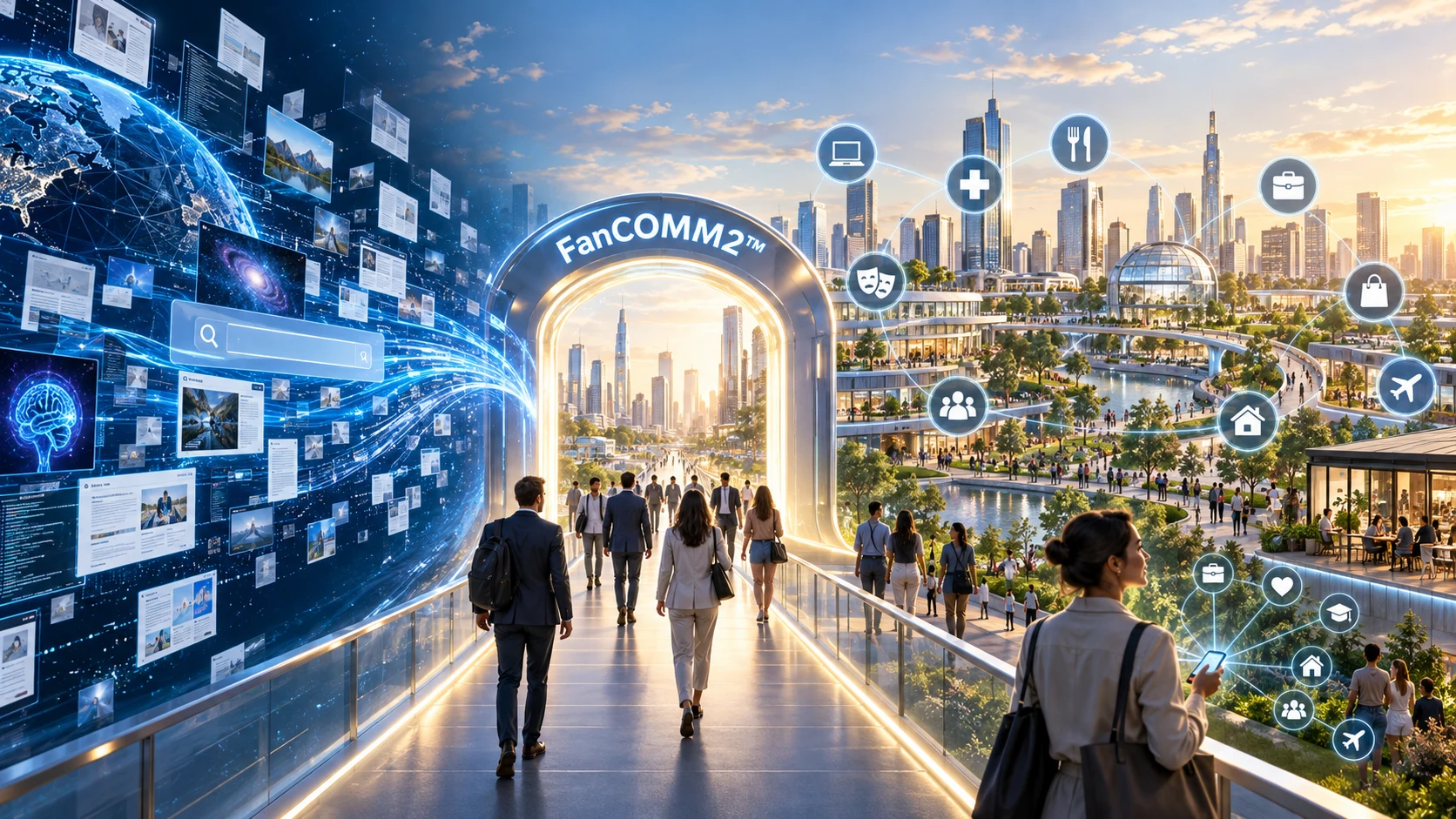
By Manoj Padhi
Founder & CEO, Fan’sGlobal SocialNGN LLC dba 4FANZ®
The physical world has always had both organized and organically developed spaces.
We build planned cities, business districts, shopping malls, office parks, hospitals, entertainment districts and residential communities. We create specialized places because organization makes discovery and interaction easier. If you need a doctor, restaurant, lawyer, technology company or movie theater, there are recognizable places to look.
The Internet evolved differently.
The World Wide Web became an extraordinary open universe of independently created websites and pages. Search engines solved the resulting discovery problem by crawling, indexing and ranking that information.
It worked remarkably well.
But more than three decades after the Web became mainstream, an interesting question remains:
Where is the digital equivalent of the planned city?
That question became the starting point for FanCOMM2™, a commerce-focused Internet architecture we recently launched at 4FANZ.
Our thesis is that the Internet does not need to replace the World Wide Web. It needs another layer alongside it: an organized environment built around opted-in information, structural presence, roles, communities, Hubs and commerce.
People Don't Live Their Lives as Webpages
Consider an ordinary day.
At 8 a.m., someone may stop for breakfast.
At 9 a.m., she becomes a software architect at work.
At noon, she becomes a restaurant customer.
At 3 p.m., she may interview somebody for an engineering position.
At 6 p.m., she becomes a shopper.
At 8 p.m., she may sing karaoke, watch a movie, attend a community event or listen to a local band.
At 10 p.m., she may read a book or look for somewhere to travel.
Tomorrow morning, she becomes the software architect again.
The person never changed.
Only the role changed.
Yet much of our digital world evolved around separate destinations for separate slices of that person's life.
Professional networking and white-collar recruiting became strongly associated with LinkedIn. Social relationships and communities developed around platforms such as Facebook. Visual promotion became central to Instagram. Public conversation found a home on X. Video and talent developed around other platforms.
These products serve different purposes, but the underlying people frequently overlap.
Why should a job opportunity effectively remain inside a professional-networking environment when qualified candidates spend substantial parts of their lives elsewhere?
Why should someone's professional identity and creative talent rarely intersect?
The software architect performing karaoke on Saturday night is still a software architect.
The physician playing guitar is still a physician.
The restaurant customer watching a community concert may also be a CEO looking for performers for a corporate event.
The DJ may also be a cybersecurity engineer looking for a new position.
The artificial separation of these roles can become an obstacle to discovery, visibility and opportunity.
Organize Everything, But Don't Artificially Separate the Human Being
FanCOMM2 takes a different architectural approach.
Instead of organizing the Internet primarily around individual platforms, it attempts to organize participation around roles and Hubs.
Technology companies can participate in Technology Hubs.
Healthcare providers can participate in Healthcare Hubs.
Restaurants can participate in Food Hubs.
Employers and job seekers can participate in Jobs Hubs.
Performers can participate in Entertainment and Talent Hubs.
Real estate, automobiles, books, movies, education, legal services, shopping and other activities can have their own structural environments.
Geographic Hubs can further organize activity around cities and local communities.
But the person participating in these environments doesn't have to become a different human being every time.
This leads to one of the principles behind FanCOMM2:
Organize everything—but don't artificially separate the human being.
Fan + Community + Commerce
Real-world economic activity rarely begins and ends with a transaction.
People become regular customers of restaurants.
They follow musicians.
They support local businesses.
They belong to alumni groups.
They participate in cultural organizations.
They recommend physicians.
They attend events.
They follow movies, authors and entertainers.
They work for companies while simultaneously participating in communities completely unrelated to their jobs.
This intersection led us to the three elements at the center of FanCOMM2:
Fan. Community. Commerce.
A fan relationship can become a community relationship.
A community can create visibility.
Visibility can help talent.
Talent can create events.
Events create sponsorship opportunities.
Sponsorship connects businesses with communities.
And those relationships can create commerce.
Instead of treating these as unrelated digital activities, we believe they can exist inside one organized architecture.
What If Businesses Told the Internet Who They Are?
There is another fundamental difference in the model: opted-in data.
Traditional search engines perform an extraordinarily difficult task. They crawl enormous quantities of information, index it and attempt to determine what is relevant to a query.
AI systems have introduced another layer. Increasingly, users can ask a question and receive a synthesized answer without necessarily navigating through the same sequence of websites that characterized traditional search.
That raises an important question for businesses:
Why should the Internet always have to reconstruct who your business is when your business can tell the Internet who it is?
FanCOMM2 is being built around information intentionally provided by participating businesses and users.
Every eligible business can establish one standard page free of charge.
A restaurant can present its food and services.
A physician's practice can describe its services.
A technology company can showcase products and solutions.
A performer can establish a talent presence.
A realtor can identify the markets and services they cover.
A business requiring a broader presence can create additional pages and participate more deeply through FanCOMM2's patent-pending Hub architecture and relevant industry, marketplace and geographic Hubs.
The objective is not to eliminate open-Web search.
It is to introduce another discovery model:
Crawled information and opted-in information can coexist.
From URLs to Structural Presence
A URL tells us where a resource exists.
But what if a digital address also communicated something about the entity occupying it and its place within a larger ecosystem?
In the physical world, location provides context.
A store inside a shopping mall exists within a commercial environment.
A physician inside a medical complex exists within a healthcare environment.
A technology company exhibiting at a technology conference exists within an industry context.
FanCOMM2 attempts to bring some of that structural context online.
A business can establish a recognizable presence such as:
Brand.4fanz.com
It can then participate in relevant Hubs, marketplaces, geographic communities and customer relationships.
The idea is closer to digital urban planning than another social feed.
The Internet Also Has a Trust Problem
The early consumer Internet had an understandable priority: growth.
The more people who joined a network, the more useful the network could become.
Over time, however, enormous open networks encountered another problem:
Who is actually behind the account?
Internet platforms consequently developed verification systems, business verification, badges, reputation mechanisms and other trust signals.
These mechanisms can be valuable.
But they also raise an architectural question:
What if context and trust considerations were designed into an Internet architecture from the beginning rather than being treated primarily as additional signals around an account?
That is another principle behind FanCOMM2.
Trust Should Be More Than a Flag
A badge can provide a useful signal, but context can potentially tell us much more.
Who is participating?
In what role?
What business, profession, talent or organization does that person represent?
Which Hub is relevant to that role?
What structural presence does the business maintain?
What information did the participant intentionally provide?
How does that participant relate to the communities and marketplaces in which they operate?
FanCOMM2 is designed around this combination of identity, roles, opted-in information, structural presence and Hubs.
A physician can participate as a physician.
A technology company can participate as a technology company.
A singer can participate as a performer.
And the physician may also be the singer.
The architecture should understand both roles without confusing them.
This does not mean that an opted-in profile makes every statement automatically trustworthy. No architecture can simply declare every participant or every claim true.
The goal is more practical: provide stronger structural context from which identity, relationships, verification and reputation can develop.
The progression we envision looks something like this:
OPTED-IN DATA → IDENTITY → ROLE → STRUCTURAL PRESENCE → HUB → COMMUNITY → TRUST → COMMERCE
Connecting the Daytime Economy With the Talent Economy
This architecture creates another possibility that interests us deeply.
There is enormous creative talent hidden inside the daytime professional economy.
Engineers sing.
Doctors play instruments.
Executives perform.
Students dance.
Accountants write.
Entrepreneurs make films.
But our digital systems have often treated "professional" and "talent" as separate identities.
We believe connecting them can create an entirely different community economy.
A technology company sponsoring a local music event isn't merely buying advertising. It can be supporting people who may themselves be engineers, customers, employees or future employees.
A physician sponsoring local performers can simultaneously participate professionally and contribute to community life.
Restaurants and venues can support talent while gaining community visibility.
Corporations can connect their commercial presence with community participation and social responsibility without requiring every employee or executive to become a social-media influencer.
That creates a bridge between the daytime professional economy and the after-hours talent economy.
For us, that is not a side feature.
It is part of what Fan + Community + Commerce means.
Discovery Should Be Able to Become a Relationship
Today's Internet is extremely good at helping people discover things.
But discovery is not the same as a relationship.
Suppose you discover a restaurant and enjoy dinner there.
Why should that relationship effectively reset after you walk out the door?
Why should the restaurant have to buy another advertisement, hope you see another social post or wait for you to search for it again?
The same applies to a performer, movie theater, retailer, physician, realtor or community organization.
In real life, relationships persist.
We therefore believe Internet architecture should make it easier for discovery to evolve into an opted-in, persistent relationship.
In FanCOMM2, the intended progression is:
DISCOVERY → CONNECTION → COMMUNITY → COMMUNICATION → COMMERCE
The business should not have to rediscover its customer every morning.
And the customer should remain in control of which relationships continue.
This Is Not an Argument to Destroy the Web
The World Wide Web is one of humanity's most consequential technologies.
FanCOMM2 is not based on the assumption that it should disappear.
Planned cities did not eliminate rural communities.
Shopping malls did not eliminate independent stores.
Business districts did not eliminate residential neighborhoods.
Different structures coexist because they solve different problems.
The same can be true online.
The World Wide Web can remain an enormous open information universe.
Search engines can continue crawling it.
AI systems can continue helping people understand it.
Social platforms can continue facilitating conversations and content.
Professional networks can continue serving professional communities.
FanCOMM2 is an experiment around a different question:
What would the Internet look like if we intentionally designed an organized, opted-in, role-aware layer around the way people actually live?
From the Information Internet to the Life Internet
The first Web connected documents.
Search engines organized access to information.
Social networks connected people.
Mobile applications organized individual services.
AI is changing how people discover and consume knowledge.
Perhaps another layer is still missing.
An Internet where a person can be a professional at 10 a.m., a customer at noon, a recruiter at 3 p.m., a shopper at 6 p.m. and a singer at 9 p.m.—without those identities being artificially separated into unrelated digital worlds.
An Internet where businesses can state who they are rather than depending entirely on machines to reconstruct their identity from scattered information.
An Internet where businesses have structural presence rather than merely another account.
An Internet where trust can be considered at the architectural level.
An Internet where talent, professional life, community participation, social responsibility and commerce can intersect.
And an Internet where discovering somebody can be the beginning of a relationship rather than the end of a search.
That is the thesis behind FanCOMM2™.
People don't live as webpages.
People live through roles, relationships, communities and commerce.
Maybe the Internet should be organized that way too.
---
Manoj Padhi
Founder & CEO
Fan’sGlobal SocialNGN LLC dba 4FANZ®
Creator of FanCOMM2™
Explore an organized, role-aware Internet
Ask the 4FANZ team how opted-in information, structural presence, Hubs, communities, talent, relationships, and commerce come together through FanCOMM2.