How Do People Discover FanCOMM2™ If It Is Just a Website on the World Wide Web?
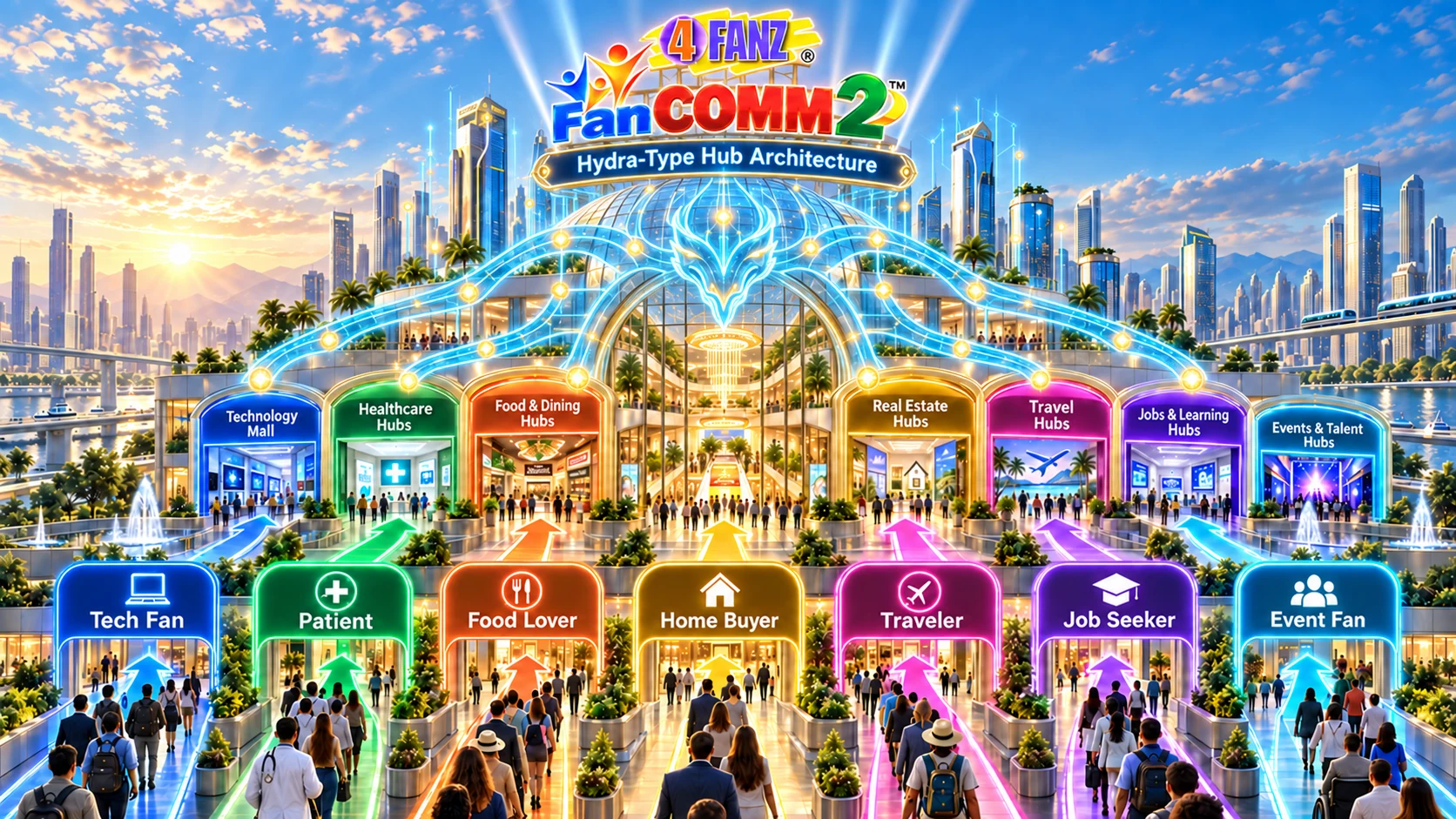
At first, this sounds like a fair question. If FanCOMM2™ is accessed through a browser, how is it different from another website waiting to be discovered among billions of pages?
The difference is architectural.
A conventional website usually has one primary entrance: its domain name. People must already know that address, find it through a search engine, encounter an advertisement, see a social-media post, or receive a link. Even a well-designed website can remain an isolated destination in the enormous ocean of the World Wide Web.
FanCOMM2™ is designed as a multi-entry—or hydra-style—Internet system. Instead of relying upon one front door, it creates many coordinated entrances that lead people into an organized, commerce-focused environment.
One Website Usually Has One Entrance—FanCOMM2™ Has Many
People can enter FanCOMM2 through:
- Their role as a customer, professional, business owner, organizer, performer, mentor, sponsor, or community member.
- Global, industry, city, ZIP-code, and local zones.
- Ecosystems built around industries, interests, services, communities, and commercial needs.
- Memorable premium domains that guide visitors toward a relevant marketplace or Hub.
- Public Oasis Hubs where businesses, people, talent, events, products, and opportunities appear in context.
- Private Fan Hubs that maintain opted-in relationships between a business and its customers.
- Universal FanCOMM2 digital business and personal cards.
- Unique QR codes that can be placed in stores, offices, event venues, flyers, banners, videos, and social-media posts.
- Direct structural addresses such as
yourbrand.4fanz.com.
These are not disconnected landing pages. They are coordinated entrances into an organized system—similar to multiple roads, signs, parking entrances, directories, and storefronts leading people into a giant digital mall serving each city.
Role-Based Architecture Begins With Declared Intent
The most important distinction is that FanCOMM2 is a role-based architecture. People and businesses state their intended role when they participate instead of entering every service as an undefined, generic “user.” Their declared roles help determine the Hubs, tools, relationships, and commercial contexts that are relevant to them.
FanCOMM2 is organized across 36 zones. A person might participate as a business owner or professional provider in only one or two zones while remaining a consumer, customer, patient, traveler, learner, audience member, or Fan across the other 34 or 35 zones. The same person can therefore have different legitimate intentions in different contexts without creating a disconnected identity for every service.
For example, a dentist may participate as a healthcare professional in the Healthcare zone and as a business owner in a local Commerce zone. That same person can still be a restaurant customer, traveler, home buyer, technology consumer, event attendee, parent, learner, or supporter of local talent elsewhere in the system. Role-based participation allows discovery and communication to begin with context rather than forcing every interaction into one undifferentiated social feed.
This layer is largely missing from the conventional World Wide Web. A person commonly registers as a generic user on many unrelated company websites, and each company offers only its own isolated collection of services, identities, data, and relationships. The participant repeatedly creates accounts while the resulting information remains fragmented across providers.
FanCOMM2 instead provides one integrated platform architecture through which many role-based services can operate: discovery, Hubs, marketplaces, business cards, LatterBox, Private Fan Hubs, events, sponsorships, talent relationships, and commerce. It does not mean that 4FANZ itself performs every professional or commercial service. Independent businesses and professionals still deliver their respective services; FanCOMM2 supplies the shared structural environment that connects those services and participants through declared intent.
From a Vast Ocean to an Organized City Mall
The World Wide Web is invaluable, but it is vast and increasingly noisy. A business website can be indexed by a search engine and still remain one page among billions. Discovery is influenced by changing rankings, advertising budgets, platform algorithms, and AI-generated answers.
FanCOMM2 is designed around structural placement. A participating business can have:
- A recognizable
4fanz.comBusinessHandle. - A permanent Hub-Booth presence in an appropriate city, ZIP code, industry, or ecosystem.
- An opted-in listing that can be discovered through iSearch.Live.
- A universal business card available through BizCards.Live.
- LatterBox™ for ongoing, permission-based communication.
- A Private Fan Hub designed to support up to 10,000 opted-in relationships.
- Fan-Commerce tools, including dispatchASAP™, for orders and business interactions.
- Connections with community organizers, events, talent, sponsorship opportunities, and complementary businesses.
The objective is not simply to publish another page. It is to give the business a recognizable position within an organized commercial and community structure.
We Are Not Building Another Yellow Pages
Today, when we approach a physician, dentist, technology company, restaurant, or other professional organization, we are not asking it to become one more static listing in a traditional Yellow Pages-style directory. We invite it to become a functioning part of the Hydra-Type Hub Architecture—an organized network in which its structural presence can be discovered naturally in the appropriate role, city, ZIP code, industry, and ecosystem context and then connected with relationship and commerce tools.
A clinic, for example, should be able to publish more than its name, address, and telephone number. It can describe its procedures, equipment, areas of care, professional roles, educational resources, and published availability. Healthcare participants can also contribute responsible educational programming and general wellness information through media destinations such as HealthCast.TV, while keeping individualized medical advice and treatment within the appropriate licensed clinical relationship.
Restaurants can similarly publish cuisines, signature dishes, menus, events, ordering options, and community participation. Technology companies can present solutions, products, implementation capabilities, demonstrations, partner opportunities, and educational programming. Each industry can develop its own media and discovery channels—effectively its own specialized TV, marketplace, Hubs, and commerce pathways—without becoming disconnected from the broader FanCOMM2 structure.
Attempting to build this model as 250 separate websites would create hundreds of isolated destinations, fragmented identities, duplicated systems, and separate audiences. Each property would still depend heavily on external search engines, social-media feeds, advertising systems, and the changing distribution decisions of large technology platforms such as Google and Meta.
FanCOMM2 instead connects more than 250 premium-domain entrances to a shared Hub architecture, common identities, opted-in discovery, universal business cards, LatterBox, Private Fan Hubs, community relationships, and commerce services. Our design thesis is ambitious: for structured, city-centered Fan-Community-Commerce, this connected model can provide a broader and more useful foundation than the ocean-style discovery model used by many large platforms and popular standalone websites. Its value must ultimately be evaluated through participation and measurable outcomes—not assumed merely because the architecture is larger in scope.
Premium Domains Become Guided Entrances
FanCOMM2 includes a growing collection of premium domains associated with industries, communities, products, services, deals, talent, and commerce. These domains can be hosted as dedicated destinations or used as memorable gateways that guide people toward the correct Hub, ecosystem, marketplace, or business presence.
For example, someone should be able to ask a useful local question such as, “Which restaurants in my city offer biryani?” A relevant marketplace can then present participating, opted-in businesses in context, together with their business cards and ways to connect.
The premium domain is therefore not merely another isolated website. It becomes one entrance in a coordinated discovery network.
Universal Business Cards Carry the Entrances Everywhere
A FanCOMM2 business card is more than an image containing a name and telephone number. It can provide a portable entrance to the business’s structural presence.
The card can carry:
- The person’s name and published role.
- The business name and BusinessHandle.
- The business’s city, state, and country.
- A QR code leading to the appropriate secure profile or business presence.
- Sharing options for text, WhatsApp, email, social media, and compatible device sharing.
- Access to LatterBox and other published relationship tools.
Businesses can display the QR code at their premises, include it on printed materials, add it to event media, or share the card online. One card can therefore become many physical and digital entrances into the same structured presence.
How Does the Network Itself Help People Discover Businesses?
One important advantage of establishing an early structural presence is the OASIS CRM outreach network.
As 4FANZ® invites businesses and professionals to join, list their products and services, and learn about community-sponsorship opportunities, recipients may return periodically to see how the Hubs and marketplaces are developing and what has become available.
A business may already use its own CRM to contact prospects and customers. Inside FanCOMM2, however, the platform and participating community organizations also conduct outreach for their own growth, events, programs, and sponsorship initiatives. Their independent promotion can create additional opportunities for participating businesses to be discovered.
This does not guarantee traffic or sales. It means another entity may be promoting the organized environment in which the business has already established its structural presence—indirectly improving its opportunity to be seen.
How People Learn That a Business Is Present
Discovery can grow through several coordinated channels:
- The business is identified as a sponsor within relevant Hubs.
- Sponsors may appear in flyers, program features, and performance or event videos.
- Event organizers can approach eligible businesses about individual sponsorship opportunities.
- Talent groups can contact businesses about albums, performances, community programs, and other collaborations.
- Employees can receive personal cloud 1OFFIS™ access and learn how their organization participates.
- Existing customers can be invited into a personal 1OFFIS relationship with the business.
- Venues, theaters, and concert organizers can promote their Fan Hubs during shows to retain an opted-in relationship with attendees.
- Businesses can display FanCOMM2 banners or QR codes at their premises and during their own karaoke, social, educational, cultural, or networking events.
- Complementary businesses can cross-promote one another or create shared local front-desk opportunities.
In the conventional Web, these services and relationships are often scattered across unrelated applications. FanCOMM2 is designed to connect them within the context of 4fanz.com, supported by more than 250 hosted or forwarding premium-domain entry points.
The Practical City Model
Imagine a city with 100,000 residents and 5,000 businesses. An average resident may interact with dozens of brands every month—restaurants, grocery stores, healthcare practices, salons, schools, entertainment venues, professional services, retailers, repair providers, and many others.
Today, each business repeatedly competes for that person’s attention through advertising, social posts, email, search results, and disconnected applications. The relationship often weakens as soon as the customer walks out the door.
FanCOMM2 proposes a different model. Participating businesses can invite customers into opted-in Private Fan Hubs and give them a personal cloud 1OFFIS through which they can communicate, place requests, discover updates, and return when they have a need.
If businesses also participate as community sponsors, part of the resulting ecosystem can support local events, talent, and organized promotional activity. Organizers can discover participating sponsors and contact them to determine their interest in relevant events.
The question is no longer only, “Who will see me after I onboard?” The business becomes structurally connected with organizers, talent, event audiences, customers, local marketplaces, and other participating businesses—the organized audience that can be difficult to reach through a general-purpose social feed.
Protecting the Customer Relationship
Social media can help with discovery, but followers remain subject to the platform’s feed, policies, and algorithms. A large follower count does not ensure that a business can reliably reach those people when it announces a new event, product, service, or offer.
FanCOMM2 is designed to support a direct, opted-in relationship between a business and its customers. Through a Private Fan Hub, 1OFFIS, and LatterBox, the relationship can remain available until the customer chooses to leave it.
The objective is not to replace every website, social network, search engine, or CRM. Businesses can continue using those tools for broad discovery while adding a persistent, commerce-focused relationship layer.
A Domain in an Ocean—or a Presence with Context?
A traditional address such as www.yourbrand.com may be indexed by Google, but it still exists among billions of pages. AI-generated answers can also satisfy a query within the search experience without sending a visit to the source website.
A Pew Research Center analysis found that users clicked a traditional search result during 8% of visits when an AI summary appeared, compared with 15% when one did not. Only 1% clicked a source link included in the AI summary.
By contrast, yourbrand.4fanz.com is intended to exist within the context of a city or ZIP code, a relevant Hub, declared roles, opted-in discovery, business cards, LatterBox, commerce, events, talent, and sponsor relationships.
The distinction is not merely another URL. It is the difference between occupying an isolated address and holding a structural position within the community and commercial environment where the business intends to participate.
This Is Not a Promise of Instant Results
If a business expects measurable results within one month, it should not join as a Sponsor based on that expectation. It can first join as a complimentary Fan, observe the platform, explore its Hubs and tools, and decide whether the long-term relationship model is appropriate.
If a business evaluates progress over a one-year horizon, it can consider establishing an early structural presence and protecting its existing customer base by offering customers a personal cloud 1OFFIS before a competitor develops that type of opted-in relationship with them. After one year, it can evaluate the actual relationships, participation, inquiries, orders, and community opportunities that developed.
Participation does not guarantee visibility, traffic, sales, sponsorship requests, or any particular commercial result.
A Premium Internet Model, Not a Viral Feed
FanCOMM2 was built as a premium, organized, commerce-focused layer that many businesses and communities have been missing. It is not designed to manufacture a viral spike that disappears and is forgotten.
Its architecture is not centered on likes, follower counts, engagement-ranking feeds, behavioral-advertising surveillance, unsolicited spam, or selling attention through algorithmic amplification. It is designed around declared roles, opted-in participation, contextual Hubs, persistent presence, permission-based relationships, and direct commerce tools.
It may be accessed through the World Wide Web, but it is not intended to behave like a conventional website with one front door. It is a coordinated, multi-entry system that guides people toward an organized digital mall for the businesses, professionals, customers, organizers, talent, and opportunities of each city.
Explore it first. Understand the model. Apply only if your business needs it.
From an Unzoned, Chaotic, and Noisy Digital Frontier to an AI-Compatible Digital Smart City
One way to understand the distinction is to imagine much of the World Wide Web as an enormous, unzoned, chaotic, and noisy digital frontier. Websites can be built almost anywhere, but there is no universal civic plan connecting identities, roles, neighborhoods, marketplaces, customer relationships, community activity, and commerce. Search engines and large platforms provide useful navigation and enforcement within their own services, yet the underlying Web does not supply one shared equivalent of real-world zoning, directories, public squares, commercial districts, relationship offices, or community infrastructure.
FanCOMM2’s Hydra-Type Hub Architecture is designed more like a planned, modern city. It is zoned by role, industry, ecosystem, geography, city, ZIP code, Hub, and community purpose, while remaining decentralized across participating businesses and relationships. Its many entrances lead into a connected structure that resembles the real world: people have roles, businesses occupy recognizable locations, industries form districts, customers choose relationships, organizers coordinate activity, and commerce happens within context.
It is also designed to be compatible with the AI era. A business’s public structural address—such as yourbrand.4fanz.com—can present its published identity, products, services, roles, locations, and relationships on an openly accessible Web page. Unlike information confined to a private account, closed group, or login-restricted social-media page, this public information can be made available for search engines and permitted AI crawlers to discover, index, and interpret. Actual inclusion and use remain subject to the page’s access controls, crawler permissions, structured data, and each search or AI provider’s indexing policies; no particular ranking, citation, or AI-generated referral is guaranteed.
The objective is not centralized control of every participant. It is a shared structural framework through which independently operated businesses, professionals, Hubs, and communities can remain distinct while becoming easier to find, understand, connect with, and transact with. In that sense, FanCOMM2 is intended to add the organized business and community layer that the open World Wide Web never structurally provided.
Explore FanCOMM2™
- Oasis Hubs
- Marketplace
- Role-Based Entrance
- Zone-Based Entrance
- Premium Domain-Based Entrance
- Opted-in Search
- Universal Business Cards
- FAQs
- Blogs
- Videos
Ready to Evaluate a Structural Presence?
Businesses can request an invitation and identify the BusinessHandle they would like reviewed. Individuals can join first as complimentary Fans and explore the system before making a business decision.
FanCOMM2™ is designed for deliberate, long-term presence—not instant advertising results. Evaluate it with confidence, understand the relationship model, and participate only when it aligns with your goals.
Find the right entrance into FanCOMM2
Ask the 4FANZ team about roles, zones, ecosystems, Hub-Booths, universal business cards, opted-in discovery, and an appropriate structural address for your business or profession.