From Algorithmic Noise to the Business Class of the Internet
Traditional social media was designed as a one-size-fits-all publishing system. Every business gets nearly the same tools: create a page, collect followers, post content, make reels, buy advertisements, and hope an algorithm delivers the message to the right people.
But restaurants, dentists, coworking providers, real-estate professionals, entertainers, hotels, news organizations, and technology companies do not operate the same way. Each role needs its own sales journey, customer experience, proof of value, and business-specific features.
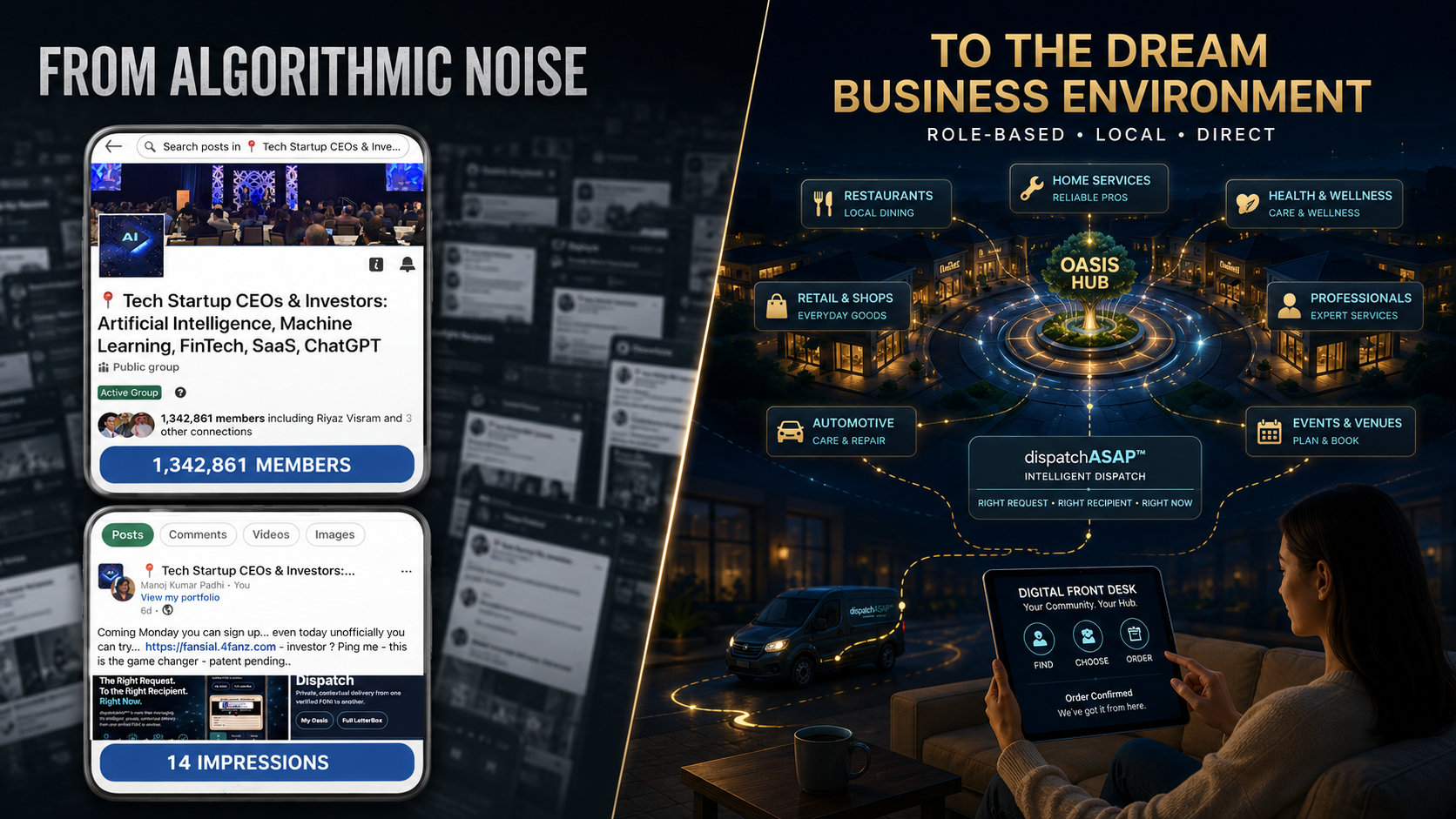
A large audience is not the same as a reachable market—and impressions are not business outcomes. Fansial Oasis is designed as the Business Class of the Internet: calmer, quieter, structured, and focused on purposeful participation.
The follower count can create an illusion
A post can be placed inside a professional group with more than 1.3 million members and still receive only 14 impressions. Those are impressions, not confirmed readers, qualified prospects, inquiries, appointments, or sales.
The problem is not necessarily the content. The platform controls distribution. A business may have thousands of followers, yet only a small algorithm-selected fraction will see a new message. The business built the audience, but it does not control access to that audience.
This is why follower counts, likes, views, and broad impressions should not be treated as the final measure of business value.
Businesses need more than another page
Consider a coworking-space provider. Its strongest proof may be the community already working there. A purpose-built platform should let that provider:
- showcase the logos and approved profiles of existing tenant businesses;
- organize members by professional role and service;
- publish available offices, amenities, meetings, and community events;
- help tenants discover, refer, and buy from one another;
- provide a Digital Front Desk for inquiries, bookings, orders, and support;
- route each request to the right recipient through dispatchASAP™; and
- expand with new coworking-specific features without forcing every other role into the same design.
Legacy platforms usually reduce this opportunity to a page, a reel, an advertisement, or an external event link. Event platforms can manage registration, but people rarely discover a local business event unless another channel first sends them the link. Every additional platform creates another disconnected audience, login, database, and marketing dependency.
The business wants thousands of buyers. The customer needs only a trusted few.
Every business would like a direct database of thousands of interested buyers. It may even want a dedicated WhatsApp group where it can post announcements and deals.
The customer has the opposite problem. A person may regularly need only 30 to 50 trusted local businesses, but cannot reasonably join and monitor 30 to 50 separate WhatsApp groups. Family, community, school, and neighborhood conversations already compete for attention.
The follower system emerged as a compromise—but algorithmic feeds reintroduced the same problem. Following a business does not guarantee that its message will reach the follower.
Search and AI have changed discovery
Search-engine optimization is not literally gone, but its role is changing quickly. Search engines increasingly answer questions directly, while AI assistants synthesize information from sources they can access and understand. A profile locked inside a closed social network may be difficult or impossible for external AI systems to read reliably.
This creates a new requirement: businesses need a structured, public, role-based presence that both people and permitted AI systems can understand. Millions of followers inside a closed platform do not automatically create discoverability outside that platform.
The Internet still cannot answer a basic city question
Amazon, Alibaba, Shopify, and other giant web services provide extraordinary infrastructure, marketplaces, storefronts, logistics, and commerce capabilities. Social-media networks provide publishing and audience tools. WhatsApp and other chat applications provide immediate communication.
Yet, despite all these enormous systems, a person still cannot reliably ask a basic question and receive a complete, current, accountable answer:
- How many doctors actively serve this city, and which of them have opted in to be reached?
- How many hospitals are represented, and which services do they provide?
- How many restaurants are actively participating in this local community?
- How many plumbers serve this ZIP code, and how can the correct one be reached?
Search results, maps, directories, advertisements, social pages, commerce listings, government records, and chat groups each show fragments. They may include duplicates, inactive businesses, missing locations, unverified claims, paid placement, or organizations that never consented to participate in a particular community. None of these systems was designed primarily as one permission-aware registry joining a declared Role, Zone, Domain, city-focused Hub, and responsible communication route.
The Fansial Oasis initiative is our first attempt to create that opt-in registry at Internet scale. Every participating person or organization can receive a unique, country-specific FONI and deliberately declare where, how, and under which role they participate. The objective is not to scrape every possible listing. It is to build an accountable census of people and businesses that have chosen to be present and reachable in the appropriate context.
This creates a competitive decision. Early participants can begin establishing their FONI, fan relationships, sponsor relationships, city presence, and operational history inside a premium environment. Businesses and professionals that remain outside may find that interested fans and customers form stronger, more convenient relationships with participating competitors. Joining does not guarantee audience growth or retention, but being absent can mean surrendering the opportunity to build those direct, opted-in relationships.
Why roles must become functional business environments
When we designed the Internet of Roles™ and the Oasis Hub System™, we envisioned millions of purpose-built, city-focused Hubs organized across approximately 36 vertical zones and a corresponding network of specialized ecosystems. Each Hub is designed to evolve with features, services, and workflows tailored to the specific needs of its role, industry, and community.
Traditional social networks were never built on this architecture. They follow an oceanic, one-size-fits-all model—placing every person, business, role, and piece of content into the same vast feed. The Oasis Hub System replaces that ocean of noise with structured, purpose-driven environments where every hub can be optimized for the people and businesses it is designed to serve.
Select a role and explore how it can benefit. The Role identifies what a participant or business does. The Zone places that role in the correct industry or activity context. The Domain gives the community a recognizable destination. The Oasis Hub adds the relevant city, market, people, sponsors, and relationships. LatterBox™ preserves the identity and purpose of a conversation, while role-specific components add the tools needed to sell, serve, collaborate, and grow.
Examples include:
- Coworking Provider: tenant showcase, availability, tours, events, referrals, and member services.
- Restaurant: menu, offers, reservations, repeat-customer ordering, and local delivery.
- Dentist or Doctor: services, accepted plans, new-patient requests, appointments, and trusted referrals.
- Realtor: property video, buyer inquiries, neighborhood context, appointments, and partner referrals.
- Performer: portfolio, availability, bookings, events, fan relationships, and sponsor connections.
- Technology Company: solutions, industries served, demonstrations, partners, resellers, and qualified inquiries.
Roles therefore become an expansion layer for sales and marketing—not merely entries in a database or email template.
The Oasis Hub model
Fansial Oasis Hubs are designed as calmer, quieter, village-style marketplaces built around roles, local relevance, privacy, and direct intent. Think of the experience as a luxury airport lounge rather than a crowded terminal: fewer distractions, clearer destinations, and more room for purposeful activity.
Instead of placing every person and business into one endless ocean of content, the system organizes discovery into purposeful hubs. Businesses can announce their presence before aggressively marketing. Customers can enter the right hub when they have a need. The environment can support structured profiles, approved relationships, offers, events, referrals, and transactions.
The model brings together:
- Role-based presence — a business is discoverable by what it actually does.
- Oasis Hubs — related businesses, customers, sponsors, and communities are organized into relevant marketplaces.
- Consent-based community migration — existing WhatsApp and social-media communities can receive Hub-specific invitations instead of being copied or discarded.
- digitalFrontDesk™ — every participant or business can have a consistent entry point for relevant people, messages, requests, orders, and service.
- dispatchASAP™ — an intelligent request can be routed privately and contextually to the right verified recipient.
- LatterBox™ — businesses and customers can communicate with greater context and less spam.
A country-specific FONI for a global network of local Hubs
Every participating user receives a country-specific FONI™—Fansial Network Oasis Identifier. Instead of reducing a person or business to a username inside one social platform, a FONI can preserve an accountable network identity while connecting the participant to the appropriate Role, Zone, Domain, Hub, profile, message, or relationship.
The architecture is designed with capacity for up to 4 billion FONIs and a long-term vision of collaboration across millions of city-focused Hubs. That scale does not require everyone to become publicly visible. A participant can join a private Fan Group, receive relevant messages, and collaborate through permission-aware relationships without publishing a searchable public profile. Public Role Census, professional, business, and social-link visibility remains an explicit choice subject to the applicable plan, verification, permissions, and Hub rules.
This combination matters: global identity capacity, local city context, and privacy by design. It allows a person to participate where relevant without maintaining a public follower list or broadcasting every relationship to the open web.
No reels. No like chasing. No follower chasing.
Fansial Oasis is not designed around an endless entertainment feed. Participants should not have to create reels merely to remain visible, chase likes to appear credible, collect followers to preserve reach, or hope an algorithm chooses the right audience at the right moment.
The goal is simpler: you, your fans, your audiences, and the businesses, reading, news, entertainment, services, or other interests that brought everyone together. Discovery begins with declared intent and relevant context. Communication retains its origin and purpose. Approved deals, discounts, alerts, and requests can reach the appropriate digitalFrontDesk through LatterBox and dispatchASAP instead of disappearing into a feed.
This is the dream web for everyone—the Business Class of the Internet—designed to feel calmer, quieter, more private, and more effective for business, community, reading, news watching, fan relationships, and fan-commerce.
What to expect when a business invites its WhatsApp or social-media community
A business may already have customers, supporters, employees, tenants, alumni, performers, volunteers, or local community members organized through WhatsApp or another social platform. The business does not have to abandon those relationships. It can send a domain- and Hub-specific Oasis invitation that gives each person a clear choice about whether and how to participate.
The invitation is not a claim that WhatsApp has been technically absorbed into Fansial. WhatsApp remains a standalone messaging system. Its private application features cannot simply be embedded inside an unrelated website. The invitation link is therefore a bridge between two systems: WhatsApp or social media can deliver the invitation, while the participant deliberately creates an Oasis identity and joins the relevant Hub through Fansial's own web application.
When a person opens a valid business invitation, the page should identify the inviting business, private Fan Group, selected premium domain, and relevant Oasis Hub. Where the Hub's plan allows complimentary Fans, the participant can then choose between:
- Fan signup — complimentary: create a basic Fan identity and write a short introduction visible only inside that private Fan Group. A free Fan does not receive a financially verified public Role Census profile, cannot publish professional social links as verified credentials, and cannot automatically enable £BOX2ME or LatterBox access.
- Role Census Member: establish the applicable paid or verified participation relationship, declare a role, create a richer role presence, add eligible social-media or website links, and opt into available £BOX2ME or LatterBox communication features.
Domains whose pricing plan disables complimentary Fan membership—such as configured dating or matrimony environments—show only their eligible membership choices. An invitation never overrides the selected domain's plan, verification, approval, privacy, or safety rules.
A private group introduction is not a public profile
People in a real WhatsApp group may recognize one another by phone number, prior conversation, or the context of the group. After migration, a short introduction helps accepted Oasis Fan Group participants understand who another member says they are and why they joined.
That introduction remains attached to the private group membership, not to a publicly searchable Fan profile. Other accepted group participants may see only limited group-directory information such as the display name, short introduction, join date, and FONI when one is available. Email addresses and phone numbers remain restricted according to the applicable permissions and authorized operational access. Because a complimentary Fan has not established the same financial relationship as a Role Census Member, the introduction must not be presented as proof of identity, licensing, employment, qualifications, or trustworthiness.
From WhatsApp conversation and Google Sheets to managed workflows
Many groups use a practical combination of WhatsApp and Google Sheets because messaging alone does not provide every operational tool they need. A message thread may announce an event, collect volunteers, request an order, assign an employee, share a property, or ask members to enter information into a spreadsheet. Over time, the conversation, form responses, sheet rows, files, approvals, and follow-up messages become difficult to reconcile.
An Oasis Hub can give invited participants web features that a standalone chat thread cannot provide by itself, including configured tools for:
- structured member and role directories;
- private group introductions and membership moderation;
- events, attendance, volunteers, schedules, and reminders;
- forms, applications, approvals, and status tracking;
- products, services, offers, referrals, and declared commissions;
- jobs, tenant listings, bookings, inquiries, and appointments;
- contextual dispatchASAP™ requests with ownership and progress states;
- Digital Front Desk routing to the responsible employee or business contact;
- persistent records that authorized participants can filter and review without searching old messages; and
- purpose-built components that can evolve for the Hub's specific role or industry.
This does not mean every Google Sheet should be imported automatically or that every spreadsheet workflow already exists in every Hub. The appropriate features depend on the domain, sponsor tier, member role, country, configured components, and permissions. The important change is architectural: information that was previously scattered across chat messages and general-purpose rows can become a structured, permission-aware workflow connected to the correct business, Hub, role, and request.
What does not happen automatically
Migration should be understood as a consent-based invitation—not as copying an audience without permission.
- WhatsApp messages and group history are not silently imported.
- A person's phone contacts are not converted into Oasis members.
- Joining Fansial and joining a sponsor's private Fan Group remain separate choices.
- A follower, phone number, or short introduction is not treated as verified professional identity.
- Private group membership is not published as a public follower list.
- Access to commerce, LatterBox, social links, posting, moderation, or sponsor tools depends on the participant's plan and permissions.
The business gains a more manageable environment, but it remains responsible for describing the invitation honestly, moderating its private group, assigning appropriate access, and using participant information only for the stated purpose.
What to expect after subscribing
The Oasis model is configured around the selected Role, Zone, Domain, city, sponsor, content, verification requirements, and Hub-specific components. Onboarding may therefore take 30–90 days after subscription. This period allows the Fansial team and participating organization to confirm the appropriate identity, placement, content, permissions, communication routes, and configured features.
Organizations with a time-sensitive launch, campaign, event, or community migration can request priority onboarding from Fan-Care through the Contact Us page. A priority request allows the team to review timing and requirements; it does not guarantee an accelerated launch until scope, eligibility, capacity, and dependencies are confirmed.
From marketing activity to customer action
The long-term vision is practical. A regular customer—often local for a small business—should be able to wake up, open the business’s Digital Front Desk, place an order or request a service, and let dispatchASAP™ route the request correctly.
No hunt through old posts. No dependence on an algorithm to rediscover a business already trusted. No need to join dozens of noisy groups. No disconnected journey across a social page, search result, event platform, messaging app, and delivery service.
This is the Dream Business Environment: a structured, role-aware, quieter marketplace where discovery can lead naturally to communication, fulfillment, and repeat business.
Why this solution?
Because businesses do not need another place to chase likes. They need an environment that can evolve around how they actually operate.
Because customers do not need thousands of random posts. They need a manageable network of trusted businesses they can find and reach when a real need arises.
And because the next generation of the Internet should measure success not only by followers or impressions, but by qualified discovery, trusted relationships, completed requests, and lasting local commerce.
No reels. No like chasing. No follower chasing. No public visibility unless you choose it. Just a country-specific identity, relevant Hubs, purposeful relationships, and a calmer route from discovery to action.