How FanCOMM2™’s Jobs Ecosystem Can Reduce Cold Calls and Cold Emails for Employers and Recruiters
Recruiting technology has advanced enormously. Employers and recruiters now use job boards, applicant-tracking systems, AI résumé matching, recruiting CRMs, automated campaigns and enormous candidate databases.
Yet the communication workflow often remains surprisingly primitive:
Find a stranger → send a cold email → make a cold call → hope for a response.
FanCOMM2™ asks a simple question: Why should recruiting still work this way?
The recruiter has a CRM. The candidate has an inbox.
These are not the same thing.
A recruiting database may contain hundreds or thousands of potentially relevant people. But a record in a CRM does not guarantee that the recruiter can reach the candidate. Between them sit crowded inboxes, spam filters, unfamiliar-number screening and a growing reluctance to answer unsolicited messages.
The recruiter may have an excellent opportunity. The candidate may be interested. Yet the two may never connect.
Even when they do, a conversation can end within seconds:
- The role requires relocation, but the candidate will not relocate.
- The compensation does not match the candidate’s expectations.
- The position is onsite, but the candidate wants remote work.
- The work-authorization requirement is incompatible.
- The candidate is qualified but not currently available.
Both sides have spent time discovering facts that could have been established before the conversation began. This is not simply a recruiter problem. It is a structural problem.
We are matching résumés when we should also be matching intent
A résumé explains what somebody has done. A recruiter also needs to understand what that person wants next.
That second dataset can include:
- Current interest in new opportunities
- Desired roles and industries
- Preferred locations
- Remote, hybrid or onsite preference
- Compensation or billing expectations
- Employment type
- Willingness to relocate
- Availability
- Work-authorization requirements
- Permission for employers or recruiters to make contact
Traditional recruiting often starts with the résumé and discovers intent through repeated emails and calls. That sequence is backwards.
What if candidates controlled the relationship?
FanCOMM2™ proposes an opted-in professional relationship layer through its Jobs ecosystem:
Candidate → Professional Presence → Current Preferences → Opted-In Relationships → Relevant Opportunities
Compare that with the common workflow:
Résumé → Recruiter Database → Email Blast → Spam Filter → Cold Call → Qualification Questions
A professional could indicate that they are open to DevOps or cloud opportunities in Dallas–Fort Worth, prefer remote or hybrid work, will not relocate, are available in two weeks and permit recruiter contact for matching roles.
The recruiter could then begin with known intent instead of interrupting hundreds of people to discover whether anyone is interested.
From cold recruiting to opted-in recruiting
Traditional recruiting
Requirement arrives → search résumé databases → export contacts → send bulk messages → call candidates → ask basic questions → discover that most are unavailable or uninterested
FanCOMM2™ Jobs vision
Requirement arrives → search relevant opted-in talent → match current preferences → present a relevant opportunity → candidate expresses interest → recruiter connects → meaningful conversation
The goal is not to remove recruiters. It is to let recruiters spend more time recruiting and less time chasing.
LatterBox™ can improve the communication layer
FanCOMM2™ includes LatterBox™, an opted-in communication environment designed to separate legitimate relationship-based messages from the noise of a general-purpose inbox.
Instead of relying entirely on:
Recruiter → CRM → Email → Spam Filter → Candidate
the relationship can become:
Employer or Recruiter → Relevant Jobs Hub → LatterBox™ → Opted-In Candidate
Email, LinkedIn, phone calls and recruiting CRMs do not disappear. They simply no longer need to carry the entire burden of creating the relationship.
Job preferences must be dynamic
A résumé may remain relevant for years. Job intent can change tomorrow:
Not looking → open to remote roles → actively looking in Dallas → unavailable until January
A Jobs ecosystem should distinguish between a qualified person and a qualified, available and interested person. The second group is far more useful to an employer or recruiter—and the distinction can reduce irrelevant outreach for everyone.
Employers need persistent talent communities
Corporate recruiting teams face the same inefficiency. A company posts a position, receives hundreds of applications and searches external databases for people who did not apply. Then the email and screening cycle begins again.
Through specialized Jobs Hubs, an employer could maintain opted-in relationships with:
- Former applicants
- Interns and students
- Previous contractors
- Employee referrals
- Alumni
- Previously qualified candidates
- Professionals interested in the company
- Future candidates who are not ready today
Instead of Job opens → recruit → hire → relationship ends, the model becomes:
Company → Talent Community → Opportunities → Applications → Employment → Alumni → Referrals → Future Opportunities
Someone who is not right for today’s position may be ideal six months from now. A persistent relationship means the employer does not have to restart from zero.
A specialized ecosystem instead of another generic feed
Recruiting has workflows that restaurants, healthcare practices, retailers and entertainment businesses do not. FanCOMM2™ is therefore designed around focused ecosystems and role-based Hubs rather than forcing every interaction into one social-media feed.
The Jobs ecosystem can connect:
Candidates → Recruiters → Staffing Companies → Employers → Hiring Managers → Universities → Interns → Training Providers
Within this vision:
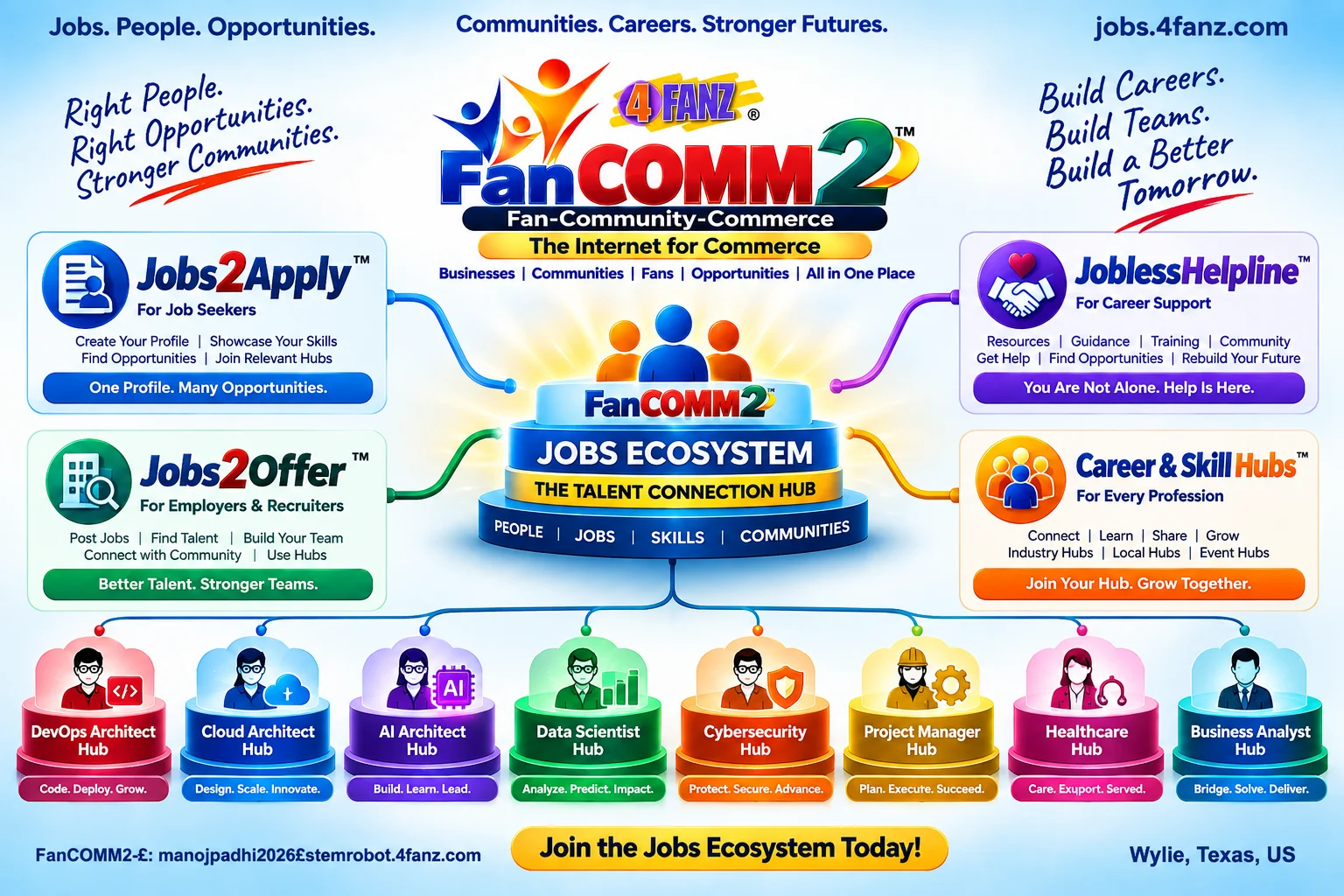
- Jobs2Apply™ supports job seekers, professional profiles, skills and relevant opportunities.
- Jobs2Offer™ supports employers and recruiters seeking talent and building teams.
- JoblessHelpline™ can organize career guidance, training and community support.
- Career and Skill Hubs can create focused communities for DevOps, cloud, AI, data science, cybersecurity, project management, healthcare, business analysis and other professions.
- JobDashboard can help organize opportunities that are otherwise scattered across emails, texts, calls, job boards and social messages.
The objective is not another job board. The objective is better recruiting architecture.
Stop rebuilding the same candidate database
The same professional may appear in ten staffing-company CRMs. Ten recruiters may send similar emails and several may call. Candidates receive repetitive outreach, recruiters lose time and email systems become more aggressive about filtering bulk patterns.
FanCOMM2™ asks whether a better relationship architecture can reduce that duplication:
Candidate controls presence → candidate controls intent → candidate opts into relevant relationships → employers discover relevant talent → recruiters facilitate the match
From cold pitching to warm intent
Today’s model is often:
Database → Cold Email → Cold Call → Qualification → Maybe Interest
The FanCOMM2™ Jobs model is designed around:
Opt-In → Intent → Match → Opportunity → Interest → Conversation
The phone call does not disappear. It becomes more valuable. Instead of beginning with, “You don’t know me—do you have two minutes?” it can begin with, “You indicated interest in opportunities matching these conditions. Let’s discuss this one.”
We do not need more recruiting spam. We need better recruiting structure.
Recruiting has accumulated extraordinary technology while retaining an inefficient communication model. AI matching, automation, job boards and CRMs still frequently lead to the same outcome: find somebody, interrupt them and ask whether they are interested.
FanCOMM2™ points toward a different structure:
Persistent Professional Presence + Current Job Intent + Opted-In Relationships + Specialized Jobs Hubs + LatterBox™ + Employers + Recruiters + Candidates
The employer still matters. The recruiter still matters. The résumé still matters. The human conversation still matters.
The unnecessary cold chase does not have to.
A premium portal requires trusted and ethical participation
FanCOMM2™ Jobs is intended for eligible, reputable recruiters and employers with a record of publishing genuine employment opportunities. It is not intended for organizations that repeatedly post jobs on Indeed or other platforms primarily to harvest résumés, expand databases or generate unsolicited outreach without a legitimate open position.
Every application is subject to review by the FanCOMM2™ application team. The team may consider the applicant’s identity, reputation, job-posting practices, opportunity quality and commitment to the platform’s ethical guidelines before approving participation.
Because FanCOMM2™ is designed as a premium and trusted portal, payment alone does not guarantee acceptance. If an applicant pays a subscription before the review is completed and the application is rejected, the applicable subscription payment will be refunded.
This review process helps protect job seekers, responsible employers and reputable recruiters while supporting an opted-in Jobs ecosystem built on authentic opportunities, consent and professional conduct.
FanCOMM2™ Jobs Ecosystem
FAN–COMMunity–COMMerce for the employment economy.
From cold calls to known intent. From email blasts to opted-in relationships. From static résumés to current preferences. From repeated prospecting to persistent talent communities. From finding people to finding people who actually want to be found.
Explore the FanCOMM2 Jobs Ecosystem
Tell us whether you are an employer, recruiter, staffing company, job seeker, university, training provider, or career-support organization and what recruiting workflow you want to improve. Email addresses remain hidden on the public page.