dispatchASAP™ vs. WhatsApp Business and Telegram Business
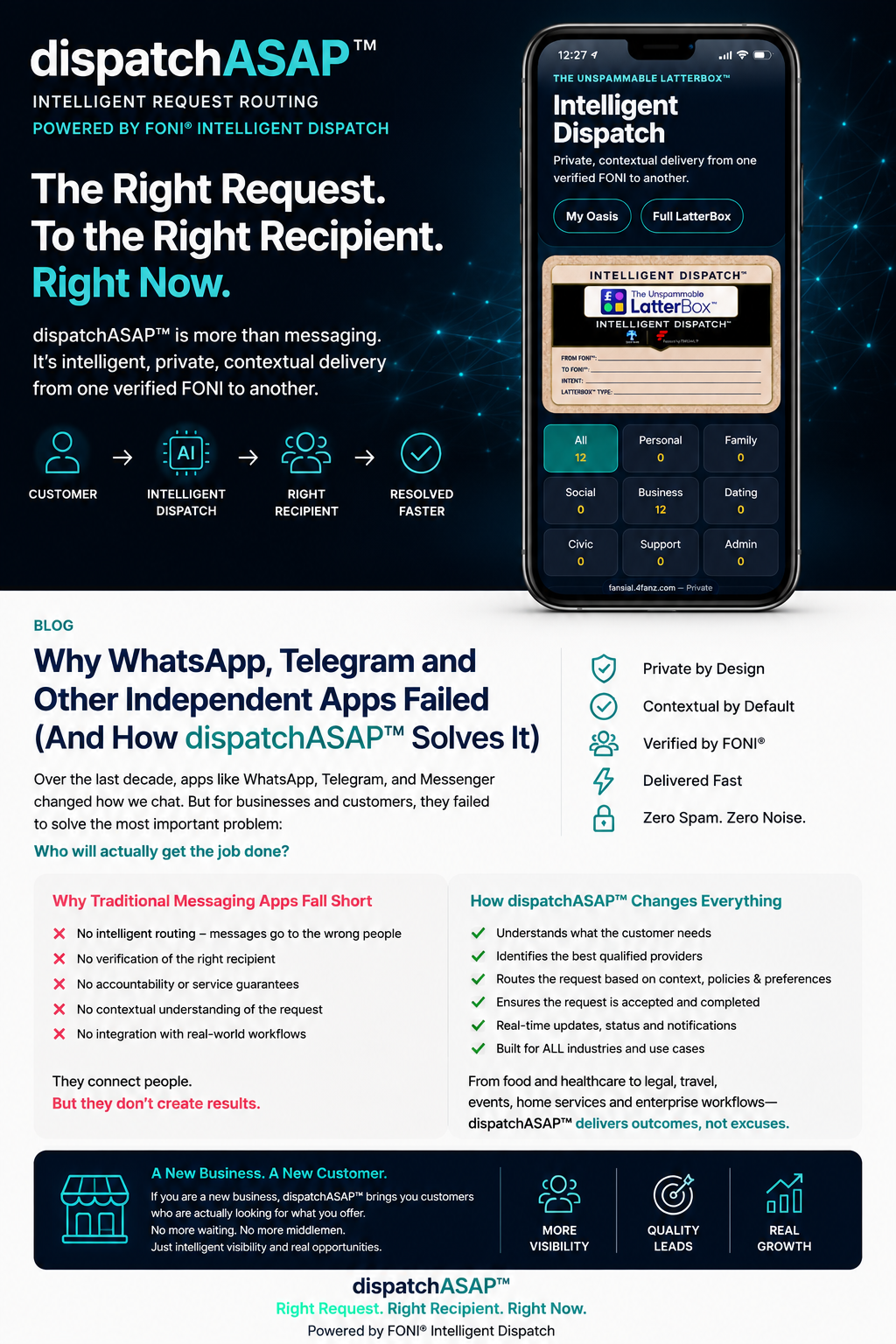
This is an architectural comparison, not a claim that other messengers failed
WhatsApp Business and Telegram Business are capable, widely used communication products. WhatsApp supports business discovery, verified business programs, structured Flows, customer opt-in controls, broadcasts, and—in supported markets—payments. Telegram Business supports opening hours, locations, quick replies, greeting and away messages, folder tags, chat links, bots, and mini apps.
dispatchASAP is being designed for a different problem: not simply how to exchange messages, but how to route a business request to an appropriately identified role, preserve its context, apply eligibility rules, and track what happens next inside the Fansial Oasis ecosystem.
A messaging feature inside a much larger collaboration system
dispatchASAP is an integral part of a potentially large, decentralized family of Fansial Oasis hubs, public profiles, premium service domains, contextual cards, LatterBoxes, sponsor relationships, Talent Groups, events, referral programs, contracts, disputes, products, and services.
A request can carry:
- From FONI and To FONI
- Intent, such as quote, sponsorship, referral, support, order, event, contract, or dispute
- LatterBox type and message category
- The relevant hub, service, public profile, product, event, or agreement
- The sender's role and current participation level
- Approval, delivery, acknowledgement, validity, renewal, and resolution state
This makes the message part of a workflow rather than an isolated chat bubble.
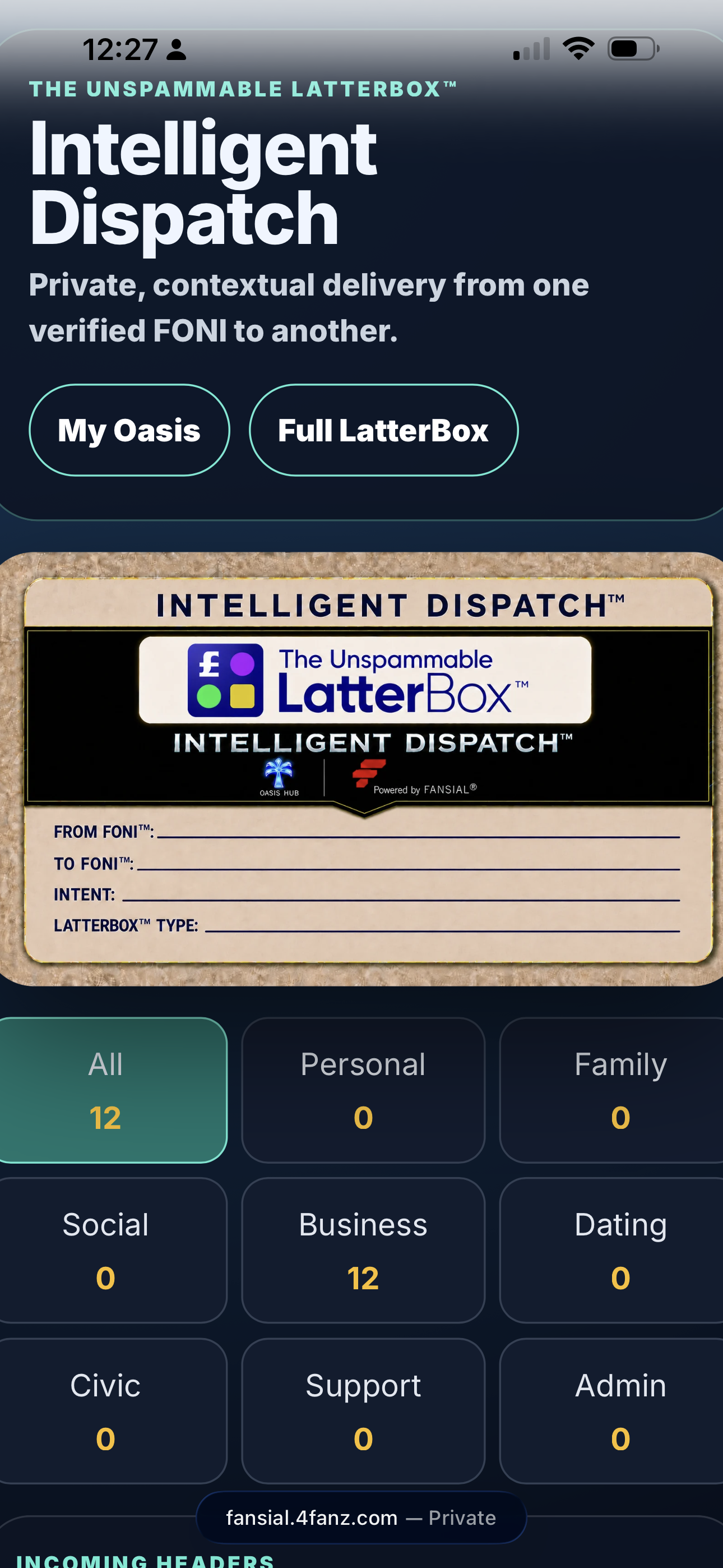
Categories organize the work
A conventional inbox often mixes family, friends, customer questions, vendors, social conversations, groups, promotions, and support. Both WhatsApp and Telegram provide useful organization features, including business tools, labels, folders, tags, automation, and bots.
dispatchASAP goes further by making category and intent part of the Oasis object model. Personal, Family, Social, Business, Dating, Civic, Support, and Admin messages can remain separated. A business request may also be attached to a sponsor card, Talent Group relationship, product inquiry, referral card, event, contract, or dispute.
The goal is not more messages. The goal is fewer contextless messages and a clearer route to the person or role able to act.
FONI trust levels should be visible—not assumed
FONI is designed to carry contextual identity and participation information. Different FONI cards can communicate different levels of platform relationship:
- Email-verified Fan: the person has completed email verification. This is a starting identity signal, not a business verification, payment relationship, professional credential, or platform endorsement.
- Role Census participant: the person or organization has an active paid Role Census relationship recorded by Fansial Oasis. This is stronger than email verification, but it still does not prove licensing, professional quality, financial capacity, honesty, or suitability for a transaction.
- Eligible Sponsor: the organization has an active sponsor relationship and receives plan-specific business capabilities. Sponsorship is not a guarantee of an offer, product, service, or financial outcome.
- Context-specific cards: member, business, manager, owner, Talent Group, sponsor, and other cards may present the role and relationship appropriate to the current hub or workflow.
The warning for Fan-level identities
When a critical business or financial interaction involves only an email-verified Fan identity, the interface may warn:
This FONI has not established a paid relationship with the Fansial Oasis System. Email verification alone does not establish business authority, professional credentials, financial trust, or transaction safety. Independently verify the person and organization before sharing sensitive information, signing an agreement, sending money, or beginning a critical business relationship.
This warning should inform—not insult—the user. Free Fans are essential participants, customers, supporters, event attendees, and potential approved referrers. The warning simply prevents email verification from being mistaken for a higher trust level.
Does FONI make impersonation impossible?
No responsible identity architecture should promise that. Attackers can steal credentials, mislead people, compromise devices, misuse legitimate accounts, or move conversations outside the system.
FONI is intended to make impersonation harder, more visible, and more reviewable by binding contextual cards to controlled account and relationship records, showing trust levels, separating public display names from platform identifiers, recording approvals, and warning when the claimed authority does not match the available evidence.
Users must still verify high-risk requests through an independent channel and never treat a badge or card as a substitute for judgment, contracts, licensing checks, payment safeguards, or professional advice.
Where dispatchASAP differs
1. Role-aware routing
The request can be directed toward a qualified role, sponsor, Talent Group, manager, owner, service, or administrator rather than merely a phone number or username.
2. Hub and service context
A message can originate from the relevant healthcare, technology, hospitality, commerce, city, talent, event, or premium-domain surface.
3. Entitlement-aware actions
Role Census profiles receive £ Message. Eligible sponsors receive £ dispatchASAP for approved product, service, referral, sponsorship, and commerce workflows. The label communicates capability rather than pretending every account has the same authority.
4. Two-way approvals
Sponsor and Talent Group relationships, referral participation, and contract workflows can require both parties to approve before the relationship becomes active.
5. Durable LatterBox records
Titles, cards, terms, delivery events, acknowledgements, validity dates, renewals, and disputes can remain attached to the same contextual history.
6. Private relationship graphs
The system can show approved public associations without publishing every referrer, customer, recipient, or private collaborator for competitors to inspect.
7. Appropriate escalation
A dispute can be routed to an authorized administrator with the relevant agreement and history, while unrelated administrators and public users remain outside the record.
What dispatchASAP does not promise
dispatchASAP does not guarantee that a recipient will respond, accept a request, perform a service, pay a commission, resolve a dispute, or complete a transaction. It does not replace emergency services, regulated communications, legal advice, financial due diligence, or independently verified contact procedures.
It is a contextual routing and collaboration layer designed to make intent, identity signals, permissions, and workflow state clearer.
A fair conclusion
Use WhatsApp Business or Telegram Business when their reach, chat experience, automation, bots, groups, or customer channel is the right tool. Use dispatchASAP when the interaction benefits from Fansial's role, hub, FONI, sponsor, Talent Group, referral, event, product, contract, or dispute context.
These systems can complement one another. The distinctive Fansial proposition is that messaging is not the destination—it is the connective tissue of a structured collaboration ecosystem.
Official product references
- Meta: WhatsApp business tools, Meta Verified, and impersonation protection
- Meta: controls and quality measures for business messages
- Meta: WhatsApp Flows, payments, and verified businesses
- Telegram: official Telegram Business feature announcement
- Telegram: official Business API feature documentation
- Telegram: safety and impersonation reporting information