The AI Race Has No Pause Button: Why Technology Companies Need Structural Marketplace Presence Now
AI Is Both a Boon and a Bane
Artificial intelligence may become the greatest productivity multiplier the technology industry has ever created.
It can write code, generate tests, review configurations, analyze logs, create documentation, automate workflows, assist customer support, generate marketing material and increasingly participate in decisions that once required specialized technical teams.
That is the boon.
The bane is that the same capabilities available to your company are increasingly available to your competitors.
And that creates a question every technology CEO should be asking:
If AI allows several companies to build similar solutions faster, what will differentiate the winner?
Increasingly, the answer may not simply be who built the technology first.
It may be:
**Who became discoverable first.
Who acquired customers first.
Who accumulated trusted reviews first.
Who learned from customers first.
Who improved the product first.
Who established structural marketplace presence first.**
---
Some AI Leaders Want to Slow Down. But Will the World Slow Down?
Some of the most prominent people in AI have warned about moving too quickly.
Their concerns deserve serious consideration. Advanced AI presents genuine questions involving safety, employment, misinformation, cybersecurity, governance and even geopolitical stability.
But there is a practical problem:
There is no worldwide agreement that everyone will slow down together.
Imagine one company decides to slow its AI development substantially.
Its competitor may not.
Imagine American companies slow down.
Will every Chinese company slow down?
Will every European company?
Will every startup?
Will every open-source developer?
Will governments pursuing strategic AI capabilities?
Probably not simultaneously and to the same degree.
That creates the classic competitive dilemma:
If one player keeps pace, others feel pressure to keep pace.
AI therefore isn't merely a technology race.
It is becoming a business, economic and geopolitical race.
---
China Demonstrates How Strategic AI Has Become
China presents an especially interesting dimension.
The Chinese government is simultaneously investing heavily in AI while attempting to control the political and information risks associated with increasingly capable systems.
There is an inherent tension.
AI can strengthen governments through surveillance, automation, economic productivity and military capabilities.
But powerful AI systems can also make information easier to generate, analyze and distribute.
For a tightly controlled political system, that creates governance questions that go far beyond technology.
The larger lesson for CEOs is not about China itself.
It is this:
AI has become too strategically important for the world simply to stop competing.
Even when leaders recognize the risks, competitive pressure remains.
---
Look at What Is Already Happening to Technology Work
You don't need to predict artificial general intelligence to understand the disruption.
Look at ordinary technology work today.
Software development is becoming AI-assisted.
Developers increasingly use AI to generate functions, troubleshoot problems, refactor applications and understand unfamiliar codebases.
Quality assurance is changing.
AI can generate test cases, analyze failures, identify anomalies and automate portions of testing that previously required significant manual effort.
Cloud and DevOps work is changing.
Infrastructure configurations can increasingly be analyzed against security and operational policies. AI-assisted tools can recommend—and, when appropriately authorized and governed, sometimes execute—remediation.
Documentation is changing.
Support is changing.
Operations are changing.
Security analysis is changing.
The important question isn't:
“Will AI replace every engineer?”
It is:
How many people will tomorrow's company require to accomplish what today's company requires 100 people to accomplish?
That is a very different question.
---
Engineers Are Already Reading the Direction of the Market
There is another interesting signal.
Technology professionals are increasingly pursuing AI skills and certifications because they see where investment and hiring attention are moving.
That does not mean cloud expertise, cybersecurity, networking, databases or DevOps suddenly become irrelevant.
AI still runs on infrastructure.
But the nature of the work is changing.
A cloud engineer who once manually investigated hundreds of configuration issues may increasingly supervise AI-assisted systems performing part of that analysis.
A developer may become responsible for directing and reviewing AI-generated code rather than writing every line manually.
A QA engineer may supervise increasingly autonomous testing pipelines.
The profession doesn't necessarily disappear.
The productivity ratio changes.
And when productivity changes dramatically, organizational structures eventually change with it.
---
Now Think About Your Technology Company
Suppose your company spent two years developing a product.
Perhaps you believe:
“Our technology is unique.”
Maybe it is.
But AI introduces an uncomfortable possibility.
What if three other companies can now build something similar much faster?
Before AI, recreating your product might have required:
20 engineers × 18 months.
Tomorrow, perhaps a smaller AI-assisted team can build a credible competitor dramatically faster.
The exact numbers will differ by product.
But the direction is important.
The cost of creating competing technology is falling.
That means building the product is only part of the battle.
The next battle is:
Who gets discovered?
---
Your Competitor May Be Inside TechMalls While You're Still Posting
Imagine two companies have comparable products.
Company A
Builds the product.
Creates a LinkedIn post.
Gets 200 likes.
Posts another announcement two weeks later.
Runs another campaign.
Eventually the posts disappear down the feed.
Company B
Builds a comparable product.
Creates permanent structural marketplace presence.
Lists the solution under appropriate technology categories.
Receives inquiries.
Gets customer feedback.
Builds reviews.
Learns what buyers actually need.
Uses AI to implement customer-specific improvements quickly.
Improves the product.
Gets more customers.
Gets more reviews.
The difference becomes increasingly significant.
Not necessarily because Company B originally had better technology.
Company B built a better discovery-and-feedback loop.
---
AI Makes Customer Feedback More Powerful
This may become one of AI's most important commercial effects.
Historically, customers might request ten product improvements.
The vendor would prioritize two because engineering resources were limited.
AI can potentially compress that cycle.
A customer says:
“We need this integration.”
AI assists the development team.
Another says:
“We need this workflow.”
AI accelerates implementation.
Another requests:
“Can this work with our cloud environment?”
The engineering team can potentially prototype and validate the change faster.
Therefore:
Discovery → Customer → Feedback → AI-Assisted Enhancement → Better Product → Better Reviews → More Discovery
becomes a powerful cycle.
The company already participating in that cycle can develop an advantage over a company waiting for people to discover its occasional posts.
---
A Product Shouldn't Spend Its Life Making Rounds on LinkedIn
LinkedIn is valuable.
Keep using it.
Announce your product.
Share your expertise.
Build your professional network.
But consider the absurdity of spending millions developing technology and giving the product primarily a temporary social-media presence.
Your engineers spent years creating it.
Why should its visibility disappear in days?
This is the principle behind TechMalls.com.
Your existing TechMalls vision already makes this distinction clearly: professional networking and technology commerce solve different problems, and technology products need persistent categories, showrooms and marketplace discovery—not merely temporary posts.
---
Technology Products Need Shelves
Walk into a physical store.
Televisions have a section.
Computers have a section.
Phones have a section.
Customers compare them.
Why should enterprise technology be less organized?
A $50 pair of shoes can have better marketplace organization than a $500,000 enterprise technology solution.
That is precisely the structural problem TechMalls.com is intended to address.
The model becomes:
Company → Solution → Category → Buyer → Comparison → Connection → Opportunity
Instead of:
Post → Likes → Feed → Disappearance → Post Again
Your existing TechMalls framework describes the same transition succinctly:
List → Categorize → Showcase → Discover → Compare → Connect.
---
And Technology Companies Are Both Buyers and Sellers
There is another reason a technology marketplace makes sense.
No technology company is truly self-sufficient.
A cybersecurity company buys cloud infrastructure.
A cloud company buys security products.
An AI company needs compute.
A SaaS company needs DevOps.
A DevOps company needs monitoring.
A consulting company needs software partners.
A software company needs implementation partners.
An American company may need an overseas delivery partner.
An overseas technology company may need access to American customers.
Technology companies therefore occupy both sides of the marketplace:
They Buy Something. And They Sell Something.
That is why a public solutions hub can become more than another vendor directory.
It can become an ecosystem for:
Buyer → Seller
and:
Technology Company → Technology Company → Partnership → Customer Solution
That vendor-to-vendor partnership opportunity is also central to the TechMalls model.
---
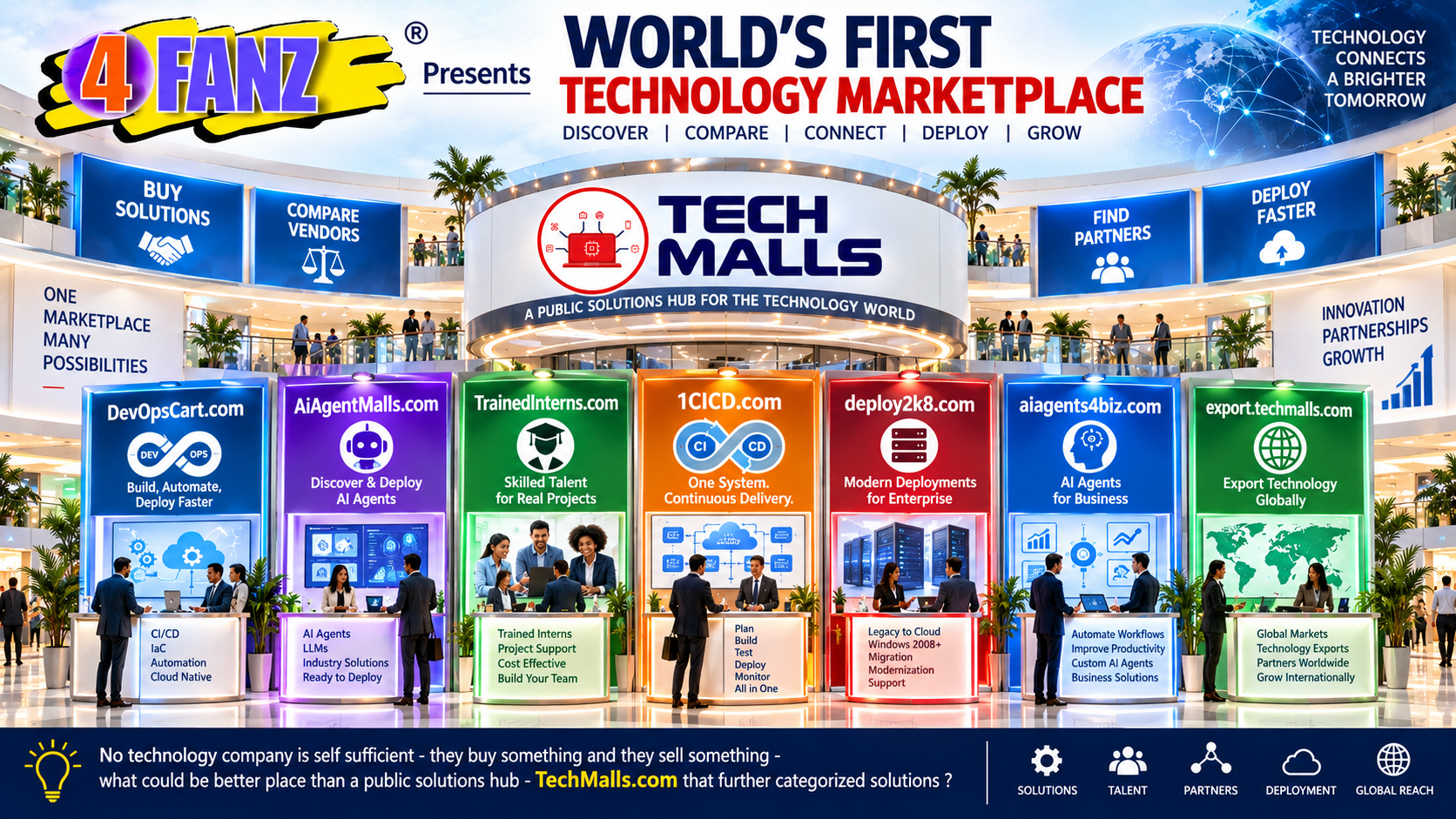
TechMalls.com: A Public Solutions Hub
This is why 4FANZ® presents TechMalls.com as a Technology Marketplace.
Different technology needs can have specialized destinations, including:
DevOpsCart.com
DevOps solutions, automation and delivery.
AiAgentMalls.com
AI agents and AI solutions.
TrainedInterns.com
Trained technology talent and project resources.
1CICD.com
Continuous integration and continuous delivery.
deploy2k8.com
Deployment and modernization solutions.
aiagents4biz.com
AI agents for businesses.
export.techmalls.com
Technology solutions positioned for international discovery and export.
And these can continue expanding into increasingly specialized categories.
Because technology buyers don't need another feed.
They need somewhere to look.
---
Investors Need Transparency Too
The same structural problem exists on the investment side.
LinkedIn contains countless profiles describing individuals or organizations as:
Investor • Angel Investor • VC • Advisor • Mentor
But founders should be able to ask basic questions before submitting sensitive company information or spending time applying:
How long have you been investing?
What companies have you invested in?
Which investments are currently in your portfolio?
What stages do you actually invest in?
What industries do you understand?
What investment ranges have you historically participated in?
Where appropriate, investors can provide verifiable information about their investment history and criteria.
Transparency should work both ways.
If founders are expected to disclose their businesses, investors should establish their credibility too.
TechMalls should therefore not become a place where anyone can simply type “Investor” next to their name.
The objective should be meaningful marketplace trust.
---
FanCOMM2™ Doesn't Need a Crowd
This is an important philosophical difference.
Traditional social platforms are optimized around scale:
**More users.
More followers.
More posts.
More engagement.
More impressions.**
FanCOMM2™ should optimize for something different:
Real People. Real Businesses. Real Founders. Real Solutions. Real Opportunities.
We don't need millions of meaningless accounts simply to advertise a membership number.
We want technology providers who actually provide technology.
Founders who are actually building companies.
Investors who can establish their investment credentials.
Buyers who are actually looking for solutions.
Partners who can actually deliver.
Quality matters more than crowd size.
---
That Is Why FanCOMM2™ Will Not Be Free Forever
Trust infrastructure costs money.
Marketplace quality requires management.
Verification requires effort.
Spam prevention requires controls.
Infrastructure requires investment.
Therefore, FanCOMM2™ and its specialized marketplaces are intended to maintain an affordable subscription model rather than depend entirely on advertising or uncontrolled mass participation.
Affordable does not necessarily mean the same price forever.
As the ecosystem develops and its value grows, subscription pricing may evolve.
But the objective remains:
Keep participation affordable while maintaining marketplace quality.
And that creates an important opportunity for early participants.
Founding Sponsors Can Establish Their Presence Early and Lock In Their Founding Subscription Terms, Subject to the applicable sponsorship agreement.
They aren't merely purchasing advertising.
They are establishing early structural presence in a commerce ecosystem.
---
The AI Era Changes the Competitive Equation
Yesterday's advantage might have been:
We have 100 engineers.
Tomorrow's advantage may be:
We have 20 exceptional people + AI + customers + data + distribution + reputation.
And that changes what CEOs should prioritize.
Technology itself remains essential.
But increasingly:
Building technology without building discovery may be like manufacturing products without obtaining shelf space.
Your competitor may have similar AI.
Your competitor may have similar developers.
Your competitor may eventually reproduce similar features.
But if they establish marketplace presence first, acquire customers first, receive reviews first and use those customers to improve their offering faster—
they may create the commercial lead before you realize the technology lead has disappeared.
---
Don't Wait for AI to Decide Your Company's Future
AI may move quickly.
It may move more slowly than enthusiasts predict.
Regulation may increase.
Some AI capabilities may disappoint.
Others may exceed expectations.
Nobody can responsibly predict every outcome.
But one business principle remains remarkably stable:
Customers need to find you.
Your product needs somewhere to live.
Your solutions need categories.
Your company needs structural presence.
Your customers need somewhere to evaluate what you offer.
Your partners need somewhere to discover you.
And increasingly, AI systems themselves benefit from information that is persistent and structurally organized rather than buried inside transient feeds.
Your existing TechMalls concept captures the destination well:
“Use TechMalls.com to give the technology somewhere to live.”
---
4FANZ® Presents TechMalls.com
A Public Solutions Hub for the Technology World
Discover → Compare → Connect → Deploy → Grow
Technology companies buy technology.
Technology companies sell technology.
Technology companies partner with technology companies.
What could be a better meeting place than a structured public Technology Marketplace?
TechMalls.com
Your Technology Deserves a Shelf.
Your Company Deserves Structural Presence.
Your Customers Deserve a Marketplace.
FanCOMM2™ — Fan • Community • Commerce
4FANZ® — The Internet for Commerce.
LIVE TECHMALLS TECHNOLOGY ECOSYSTEM
Explore the Technology Ecosystem
Discover structured destinations for AI agents, cloud, DevOps, CI/CD, infrastructure, modernization, talent, enterprise software, partnerships, and technology exports.
Ask us about listing, showcasing, or sponsoring in the TechMalls ecosystem
Open the secure Technology Marketplace inquiry form to contact the TechMalls participation team. Fans-Care will be visibly copied.